
Climate services help people make informed decisions in response to climate risks. Across Africa, people involved in nature-based solutions, such as restoring and sustainably managing rural and urban landscapes, increasingly rely on these services. However, climate services can fall short if they are not designed in partnership with researchers, practitioners and communities.
A new study led published in the journal npj Climate Action by Dr Petra Holden from the African Climate & Development Initiative (ACDI) at the University of Cape Town (UCT) compared priorities for strengthening existing climate services used for nature-based solutions in Sub-Saharan Africa with priorities for entirely new climate services.
A clear finding was the strong demand for meaningful integration of scientific knowledge with Indigenous and Local Knowledge in climate-service co-production.
The study, co-authored by ARUA-CD and other African partners involved in the EU-funded ALBATROSS project, involved 530 interviews with local communities, NGOs, government, private companies and researchers across Ghana, South Africa, Kenya, Madagascar and Tanzania.
“This research highlights the risk of shallow engagement and externally led co-production processes. Developing climate services is not simply a technical exercise. We need to create the time and space for those involved to explore together what is already working, what is missing and what new possibilities might emerge,” says Dr Holden, who is a Senior Researcher and Lab Lead at the People in Nature and Climate (PiNC) Lab at ACDI.
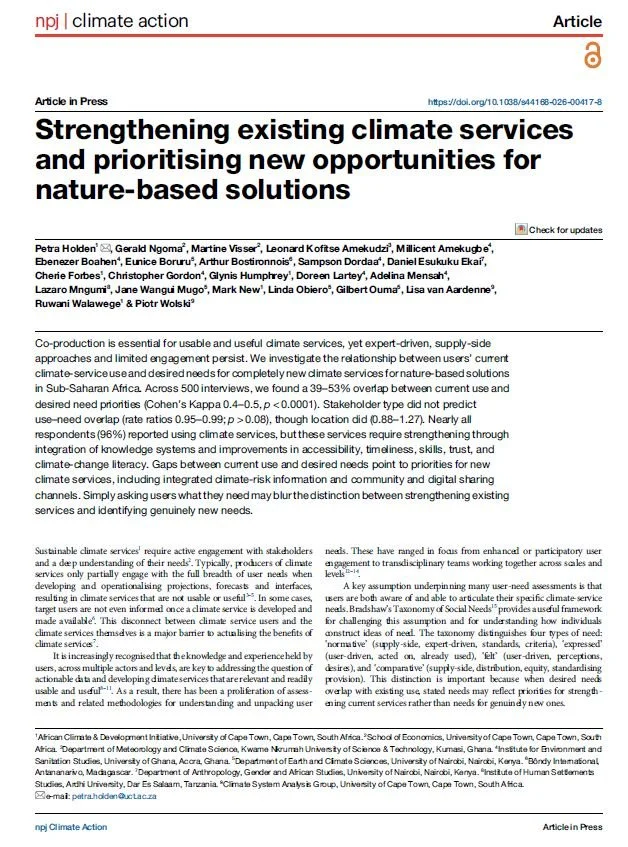
The study found that 82% of existing users reported limitations in the climate services they currently use, and more than 60% identified a need to strengthen climate change literacy. This included understanding climate change and its impacts, knowing which services are available, and having the skills to interpret and apply climate information.
“These findings highlight the importance of making climate information more accessible, timely, trustworthy and relevant to the people using it, particularly for climate services related to floods, droughts, severe winds and heat that are already in use,” says Holden.
Priorities for new climate services included combining climate information with biophysical, social, health and economic information, alongside a new focus on fire, landslides, erosion, and heat and cold extremes. Other emerging priorities were tailoring climate information to local decision-making contexts, including community, municipal and ward levels; using illustrations, animations and videos; and leveraging community radio, social media, community networks and mobile technology to share information.
“This research is particularly important for Africa because climate-service needs are shaped by diverse local contexts and experiences. Understanding these contexts and recognising the value of Indigenous and Local Knowledge alongside scientific knowledge is essential,” explains co-author Dr Cherié Forbes, Research Officer in the PiNC Lab at ACDI, UCT.
Citation
Holden, P., Ngoma, G., Visser, M. et al. Strengthening existing climate services and prioritising new opportunities for nature-based solutions. npj Clim. Action (2026). https://doi.org/10.1038/s44168-026-00417-8