
Investigating a ‘new normal’ fire season in the southwestern Cape
How do anthropogenic emissions influence the severity and likelihood of extreme fire weather? Presenting the findings from her recently submitted thesis to the People in Nature and Climate (PiNC) Lab, Isabella de Beer from the 2024 master’s cohort at the African Climate and Development Initiative (ACDI) describes tackling this critical question by focusing on the highly active 2023-24 fire season in South Africa's southwestern Cape.
From fynbos to climate science
De Beer’s academic path was shaped early on by a deep connection to the local landscape. After completing her honours degree in biodiversity and ecology at Stellenbosch University, she embarked on master’s studies in climate change and sustainable development with the ACDI at the University of Cape Town (UCT) with supervisors Tiro Nkemelang and Professor Mark New.
Her previous research focused on invasive alien trees and shrubs in South Africa. This interest stemmed from her love of the fynbos biome and her personal experience of the devastating 2017 Knysna wildfires, which were worsened by the presence of these invasive species. Wanting to understand the broader climatic drivers behind such disasters, she turned her attention to attribution science.
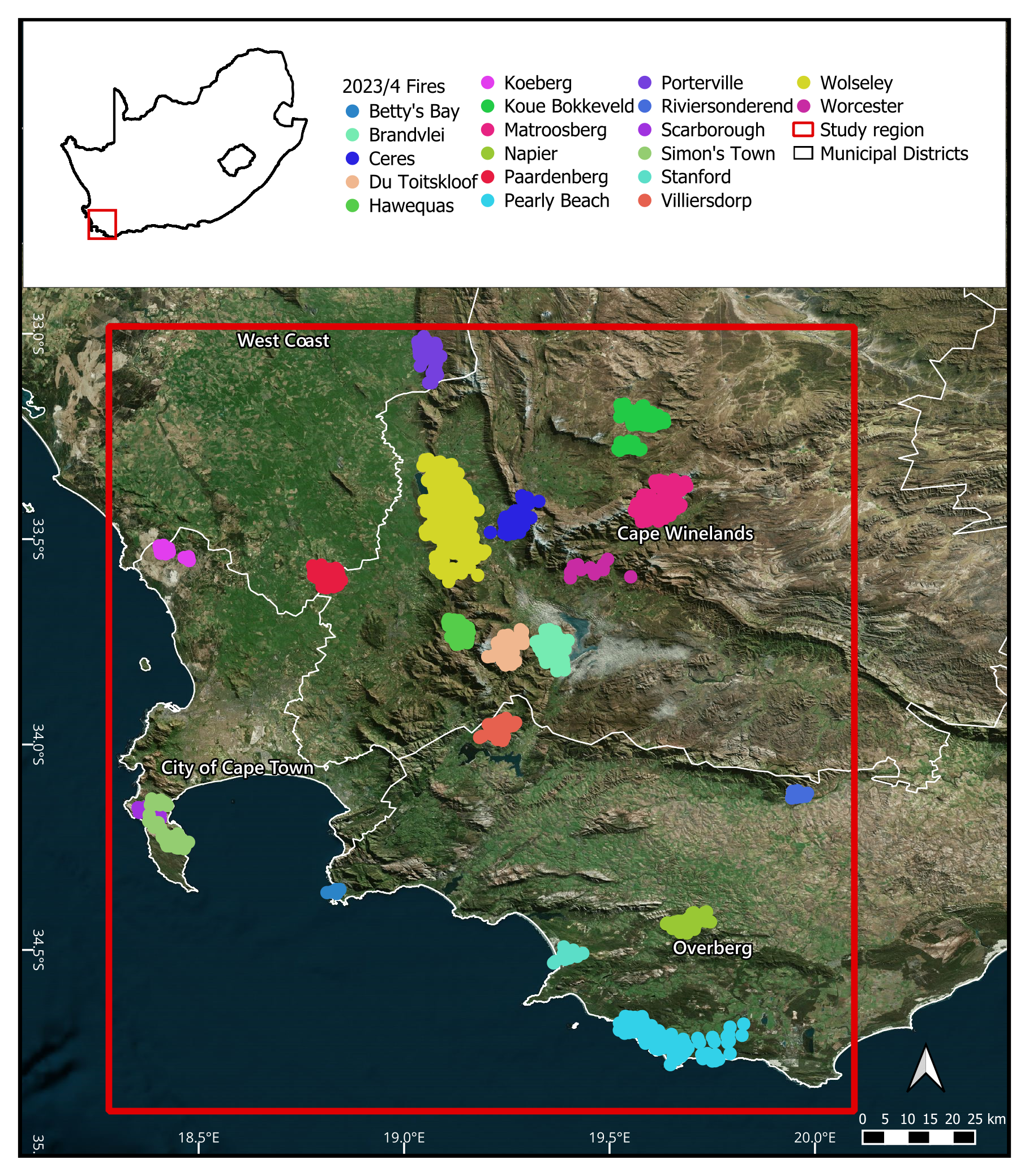
The study domain within South Africa is plotted, along with seventeen wildfires which burned during the 2023/2024 fire season. Select fires were removed from further analyses as they had a duration of less than three days. Municipal districts of South Africa are overlayed in white. Daily active fire heat signals are clustered by individual major fire events, as extracted from the FIRMS database.
Demystifying attribution science
Attribution research is a powerful tool because it allows scientists to link specific, individual extreme weather events to historic, human-induced greenhouse gas emissions.
The field relies heavily on statistical probabilities. Researchers first define the specific extreme event using real-world observational data, such as weather station records. They then use the models to calculate the probability of that event occurring in today’s climate versus the emission-free scenario, allowing them to estimate how much human activity has altered its likelihood and severity.
Revealing a stark human footprint
For her thesis, De Beer focused on the southwestern Cape, identifying 11 large wildfires and analysing regional fire weather trends over a 40-year period. This historical analysis revealed a slight but statistically significant trend toward increasingly severe fire weather.
To quantify daily fire risk, De Beer used two distinct metrics: the Canadian Fire Weather Index (FWI) and the Lowveld Fire Danger Index, considered the local South African standard. Both indices calculate risk based on daily temperature, humidity, rainfall, and wind speed conditions.
Applying a formal probabilistic attribution method, De Beer analysed the influence of anthropogenic climate change (ACC) on fire weather conditions (FWCs) during the overall fire season, as well as during the specific pre-ignition, ignition, and post-ignition windows of the observed fires. To do this, she utilised two reanalysis datasets and nine CMIP6 global climate model simulations.
Her key findings reveal a stark human footprint on the 2023-24 season:
Using the Canadian FWI: The extreme fire weather conditions (such as wind) experienced during this highly active season were made 1.59 to 2.39 times more likely due to anthropogenic emissions.
Using the Lowveld Fire Danger Index: These same conditions were found to be 1.47 to 1.79 times more likely.
Contributing to environmental conservation
These findings provide a crucial baseline for future fire management in the Fynbos biome under increasingly high, climate-altered risk levels. However, De Beer notes that there is still much work to be done.
While her thesis successfully quantified the meteorological changes to fire weather conditions, future research must address how this shifting fire regime will physically impact the highly biodiverse and fire-adapted Fynbos ecosystem.
As for her own next steps, De Beer is determined to continue contributing to environmental conservation. She hopes to transition into science communication and writing - a path that would allow her to distill and translate complex research findings for stakeholders working across the climate change space.