
Climate-resilient development pathways and adapting to a changing climate
Development pathways are understood to be the accumulation of interventions over time that shape how settlements grow and what risks and opportunities people living in those places experience. These interventions can be formal and informal, planned and spontaneous, government-led and privately-led, or done by residents and companies.
Climate-resilient development pathways (CRDPs) provide an approach to prioritise and coordinate interventions that adapt places to changing climate conditions – such as changing heat and rainfall patterns - and mitigate climate change by reducing the use of fossil fuels, making it safer for all.
CRDPs are increasingly being discussed and promoted in international science and policy circles, especially among those working to address climate change. However, it is an approach that can link several issues and efforts across sectors designed to build momentum towards positive change that is good for people and ecosystems.
CRDPs in African cities
Examples of initiatives that form steps along a climate-resilient development pathway include creating and maintaining a community food garden, soccer pitch or children’s playground that is designed to help rainwater soak into the ground after heavy rains. Or creating cool green spaces for when there are heatwaves.
It could also include restoring the banks of a river by removing solid waste, like plastic bottles and nappies, and removing invasive plants with shallow roots that block up drainage channels to increase flooding when there is heavy rain.
These interventions alone won’t eliminate climate risks, but if combined with other strategies within a development pathway – like heavy rain and heat stress early warning systems, or affordable rental housing stock – then they can build climate resilience.
This matters in African cities, like those where Tuwe Pamoja is active, because we are seeing increasing hardship caused by the loss of lives, possessions, homes, jobs and businesses due to extreme climate events like flash floods, landslides, droughts, heatwaves and wildfires.
Encouraging collective action
CRDPs can provide a framework for helping people working at different scales and in different sectors and organisations to coordinate interventions and activities, making sure that they invest time and money in things that build safety and resilience in a dynamic climate.
This potential is highlighted in an impact story involving the African Climate and Development Initiative (ACDI), in collaboration with the Climate Systems Analysis Group (CSAG) at the University of Cape Town (UCT), which supported the South African government to operationalise the climate-resilient development pathways approach.
The approach guided decisionmakers and diverse stakeholders through a process of assimilating and deliberating systemic risks, intersecting injustices, and developmental aspirations. This supported their work to analyse and negotiate multiple sets of climate adaptation, mitigation and sustainable development interventions that can be dynamically prioritised over time as conditions change.
Through this example, and the work being carried out with partners in the Tuwe Pamoja project, there is evidence that the CRDPs approach can encourage collective action that links local knowledge, experience and priorities with policies and financing flows that are being negotiated nationally and internationally.
The process is difficult, and it takes time to develop this way of thinking and working. But it is needed to tackle the root causes of climate risks, biodiversity losses and inequitable patterns of urbanisation.
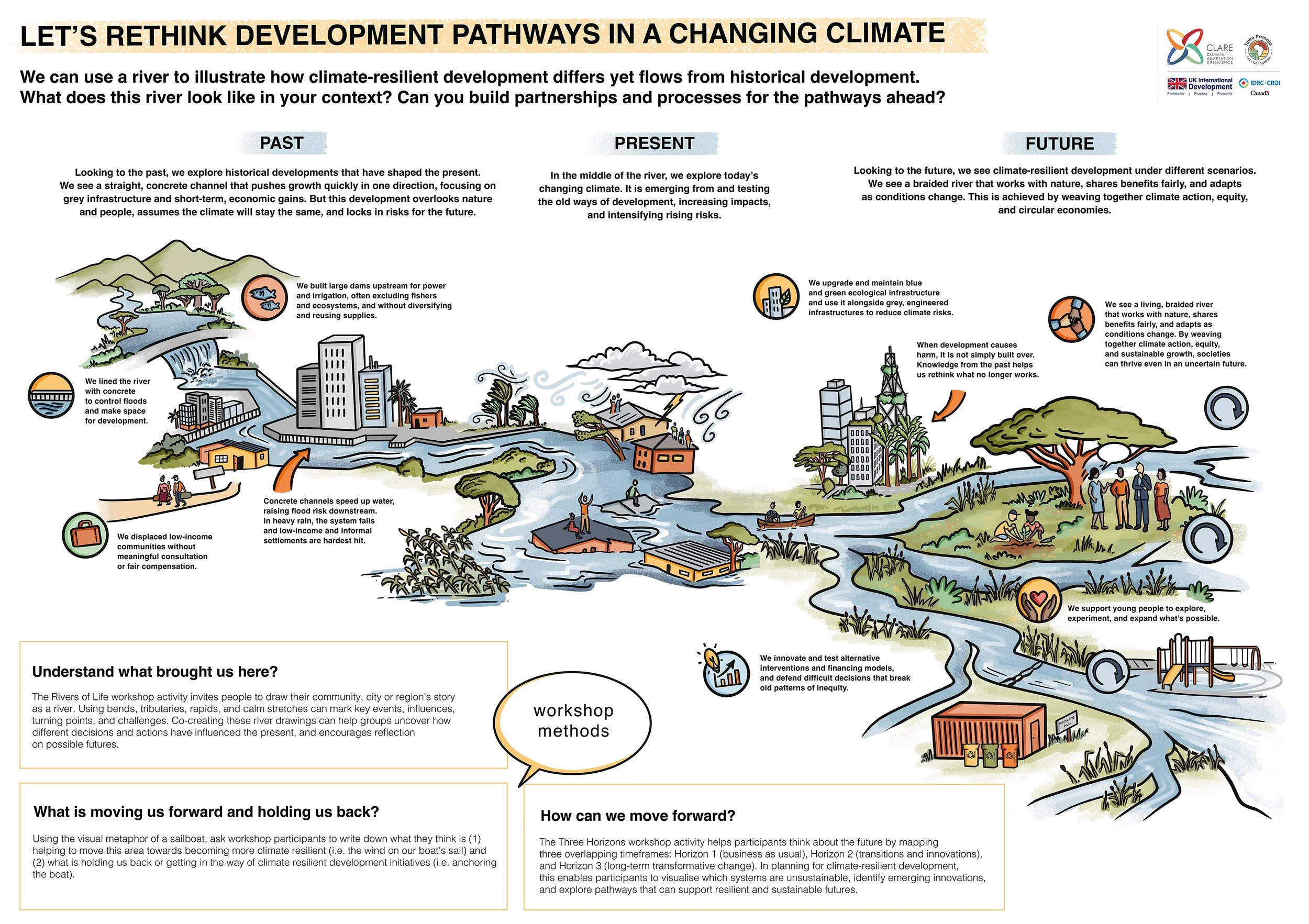
This graphic was developed to convey the concept of Climate Resilient Development Pathways (CRDPs) using the metaphor of a river, as well as to briefly introduce some methods that can be used in participatory workshops to engage with multiple stakeholders around CRDPs, especially in urban African contexts. Learn more: https://doi.org/10.25375/uct.31239703