
Dr Estelle Razanatsoa joins PiNC Lab
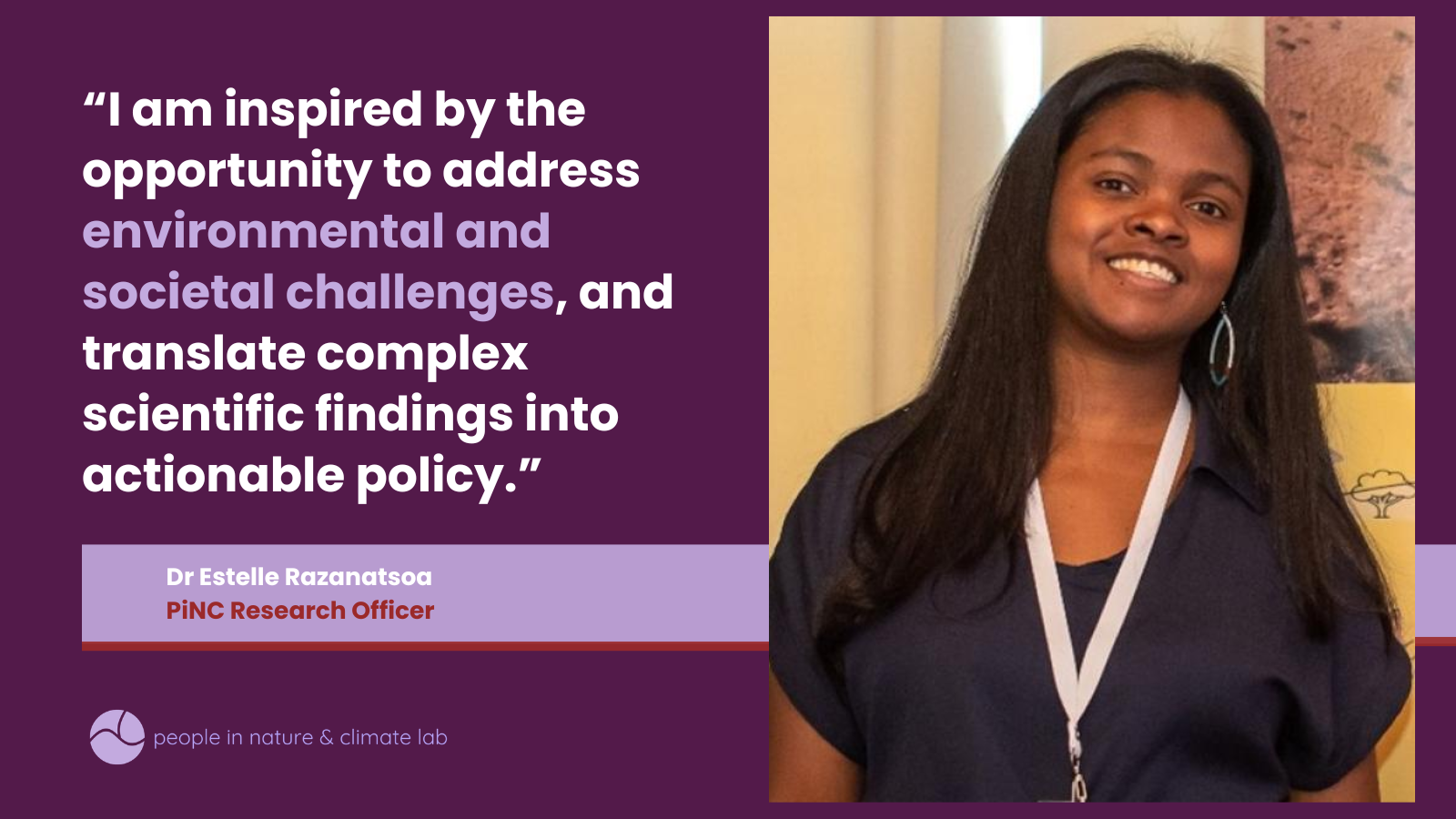
The People in Nature and Climate (PiNC) Lab is pleased to announce Dr Estelle Razanatsoa has joined the team as a Research Officer.
With experience from Madagascar, neighbouring Western Indian Ocean island nations, Southern Africa, and the Sahel region, Razanatsoa’s research focuses on sustainable and inclusive approaches to biodiversity conservation, including restoration and climate change adaptation.
“Estelle brings valuable expertise on tropical African ecosystems and diverse methodological approaches” says PiNC Lab Lead Dr Petra Holden.
“We look forward to working with her on research on interactions between climate and land use on Africa's ecosystems and biodiversity.”
Ecosystem dynamics and resilience
Razanatsoa’s research sits at the interface between ecosystems, climate, and human societies. She works on analysing and reconstructing past environmental change, climate variability, and human adaptation using palaeoecological, ecological and social datasets, and modelling.
She also explores methodological approaches that integrate empirical datasets with modelling frameworks, including Dynamic Vegetation Models, to better understand long-term ecosystem dynamics and resilience.
“I am particularly interested in understanding how ecosystems respond to climatic and anthropogenic pressures across multiple temporal scales,” Razanatsoa explains.
This perspective is particularly relevant for nature-based solutions (NbS), as many adaptation strategies in Africa have historically relied on strong relationships between people and natural ecosystems.
“By examining past ecosystem dynamics and human practices, my research can provide important insights into resilience, sustainability, and adaptation pathways that remain relevant today and in the future,” she says.
Bridging the science-policy interface
Beyond research, Razanatsoa is passionate about strengthening the science–policy interface and has actively contributed to this at local, regional, and international levels. Most notably, through her involvement with the Intergovernmental Panel on Climate Change (IPCC).
“What inspires me most is the opportunity to contribute to new knowledge that can help address environmental and societal challenges and translate complex scientific findings into actionable policy at local and international levels,” she says.
Razanatsoa says that people are an integral component of nature and biodiversity, a perspective closely aligned with the vision of the PiNC Lab.
“I am excited to collaborate with researchers at the lab from diverse disciplines who are developing innovative and solution-oriented approaches to socio-ecological challenges,” says Razanatsoa.