
Recognising co-benefits of ethical community engagement in ALBATROSS
Part of the Umzimvubu Catchment, the Matatiele community is largely rural, with livestock rearing and small-scale agriculture being the main economic activities. However, with long-term drought affecting water availability, and extreme rainfall events causing flooding that increases soil erosion, farmers in Matatiele are facing significant challenges, especially in remote and rural communities.
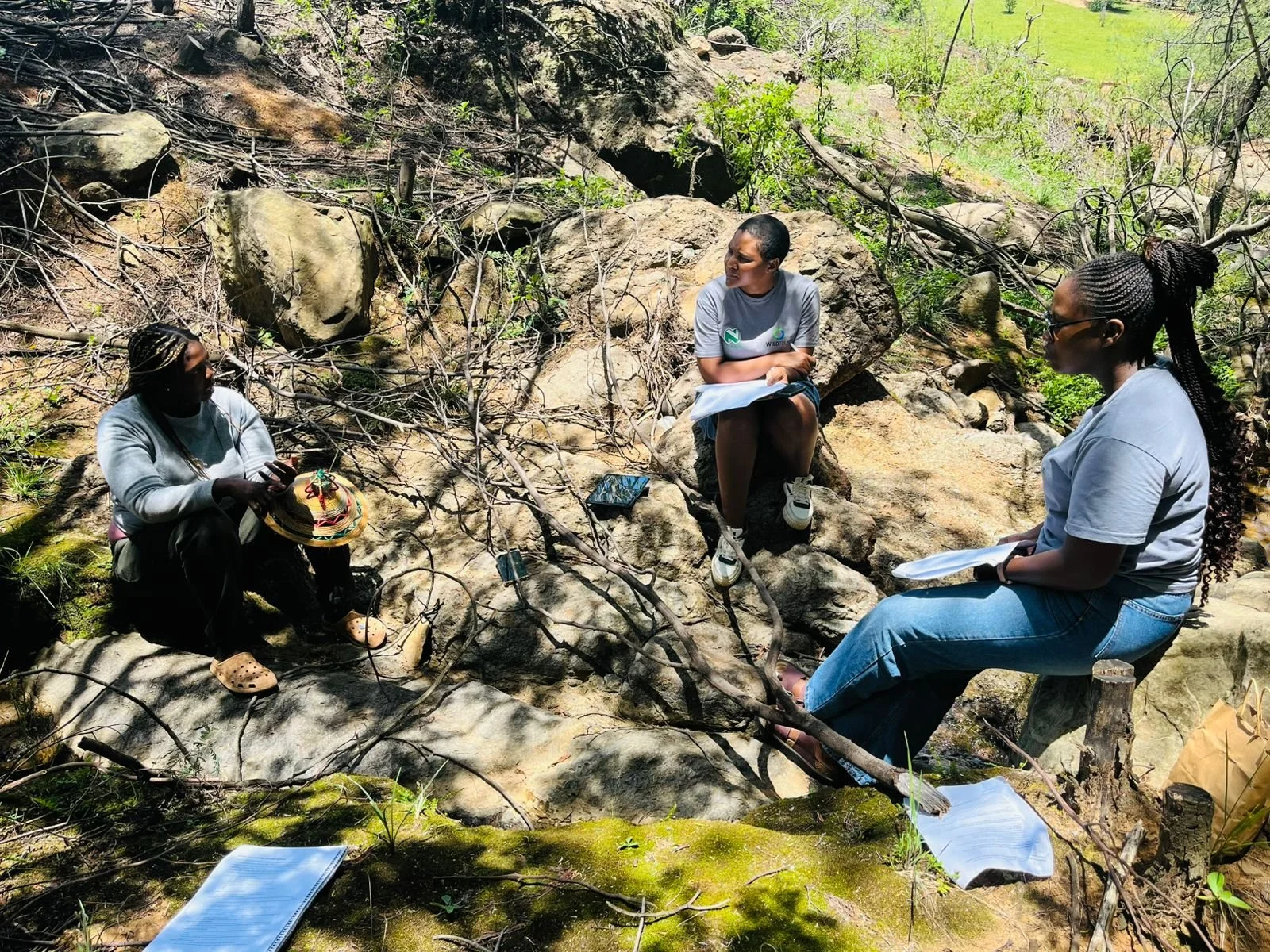
Motobatsi Nthunya was part of a five-person youth team working with the People in Nature & Climate (PiNC) Lab to collect data on the lived experiences of these community members. The five are a part of the EcoChamps programme with Environmental and Rural Solutions (ERS), an NGO based in Matatiele, in the Eastern Cape of South Africa.
Recognising the potential for a community co-benefit to the ALBATROSS project’s research in the area, PiNC Lab’s Research Officer Dr Cherié Forbes teamed up with ERS founders Nicky McLeod and Sissie Matela to facilitate training on qualitative research methods for the team of EcoChamps.
“Our EcoChamps are community residents, local project facilitators and champions of their environment. With PiNC Lab, we recognised the opportunity to enhance their skills and their confidence as agents for change in the area and in climate action,” says McLeod.
The training aimed to advocate for local expertise, where those collecting data share deep ties to the same land and language, while providing an example for similar initiatives of how research can support ethical engagement and avoid extractive practices or ‘parachute science’.
“As a South African research team working outside of the Umzimvubu Catchment community, we are very conscious of not reinforcing extractive research paradigms,” says Forbes. “From the outset, we prioritised relationship-building, shared decision-making around stakeholder engagement, and ensuring that our work creates value beyond academic outputs.”
Co-creating nature-based solutions
The ALBATROSS project is an EU-funded initiative that works with local researchers and communities in five sub-Saharan African countries (South Africa, Ghana, Kenya, Tanzania and Madagascar) to accelerate climate change adaptation by co-creating nature-based solutions and tailored climate services.
Partnering with ACDI’s PiNC Lab at UCT with a focus on South Africa's Umzimvubu Catchment Hub, ALBATROSS aims to develop climate services for nature-based solutions planning that support sustainable rangeland management and climate-smart agricultural practices.
One element of this was focused on understanding the relationship between (im)mobility and NbS. This involved collecting community perspectives relating to nature-based solutions and sustainable natural resource-based livelihoods. It also involved understanding how individuals made decisions to stay or leave their communities, and how nature-based solutions influence those choices.
Community members interpreted their own stories by identifying the economic, environmental, and well-being factors that mattered most to them. This approach was essential for understanding not just what people do, but how they make sense of climate risk, livelihood, and opportunity within their specific contexts.
Citizen-science research
The ERS EcoChamps were a natural fit to work with the PiNC Lab, as they already play a significant role in citizen-science research in their communities, by engaging with residents and offering support in areas of rangeland management and livestock husbandry. They also lead knowledge-sharing at community gatherings or ‘imbizos’.
Training with PiNC enhanced these skills, and strengthened their understanding of ethical consent and inclusive engagement across different age and gender groups. The EcoChamps gained practical experience in facilitating structured and unstructured interviews. They also worked to document narratives through an ethical collection of multilingual audio stories, participant-selected photographs, and story titling.
Training also covered a variety of qualitative research methods already used in ALBATROSS, such as co-research, co-design, and focus groups. They engaged in arts-based methodology provided by another joint ACDI-PiNC project, Tuwe Pamoja, including body and community mapping, storytelling and role playing that might be useful in other research projects.
The ALBATROSS Citizen Science Toolkit was also tested as it could be used in future to support the development of a citizen science ‘library’ of lived experience narratives that can be expanded over time.
Eye-opening experience
The result was an eye-opening experience that changed how the EcoChamps viewed their communities and their own ways of working.
For Nthunya, that meant exposure to nature-based practices that he could bring into his own farm, such as barricading vegetable gardens with maize to deter chickens and goats.
“Travelling in these different villages, and interacting with different people, showed me that you mustn't be focusing only on the things that you know. You can learn things from young people, you can learn things from older people. Life is not about age, it’s about experience,” Nthunya says.
For other trainees, like Boitumelo Mosebi, the experience pushed her to think more deeply about the value of traditional knowledge and systems.
“The experience prepared me in many ways for the future,” Mosebi says. “We need to listen to our elders, as they are encouraging us to do and be better than them in the years to come. We need to follow their guidance, because listening to them helps us make better decisions, and to do better in the environment.”
Beyond data collection
This training initiative shows it is possible to design research processes that strengthen trust and lay the groundwork for longer-term collaboration.
Working closely with the EcoChamp trainees, and collaboratively developing their technical skills, shows how both ERS and the PiNC Lab value capacity strengthening and personal development.
“PiNC’s work goes beyond data collection, with our researchers being intentional about how we can provide avenues to empower communities and centre collaborative approaches,” says Forbes.
“We are proud to work with partners like ERS and the broader Umzimvubu Catchment Partnership (UCP), who share our vision and contribute to amplifying the reach and impact of our work.”
