
Understanding gendered climate vulnerability in South Africa
Researchers at the African Climate and Development Initiative (ACDI), including PiNC Lab Lead Dr Petra Holden, have published work in the journal WIREs Climate Change, that develops and applies an intersectional climate risk framework, based on a systematic literature review of 52 articles.
The framework aims to help researchers better understand gendered climate vulnerability, and therefore inform the design and implementation of equitable adaptation responses. South Africa was used as a case study, and the researchers used a systematic approach to review literature that met several criteria regarding gender, climate hazards and risk.
“This framework helps us understand vulnerability as shaped by intersecting identities and power relations that privilege some while marginalising others," says Holden.
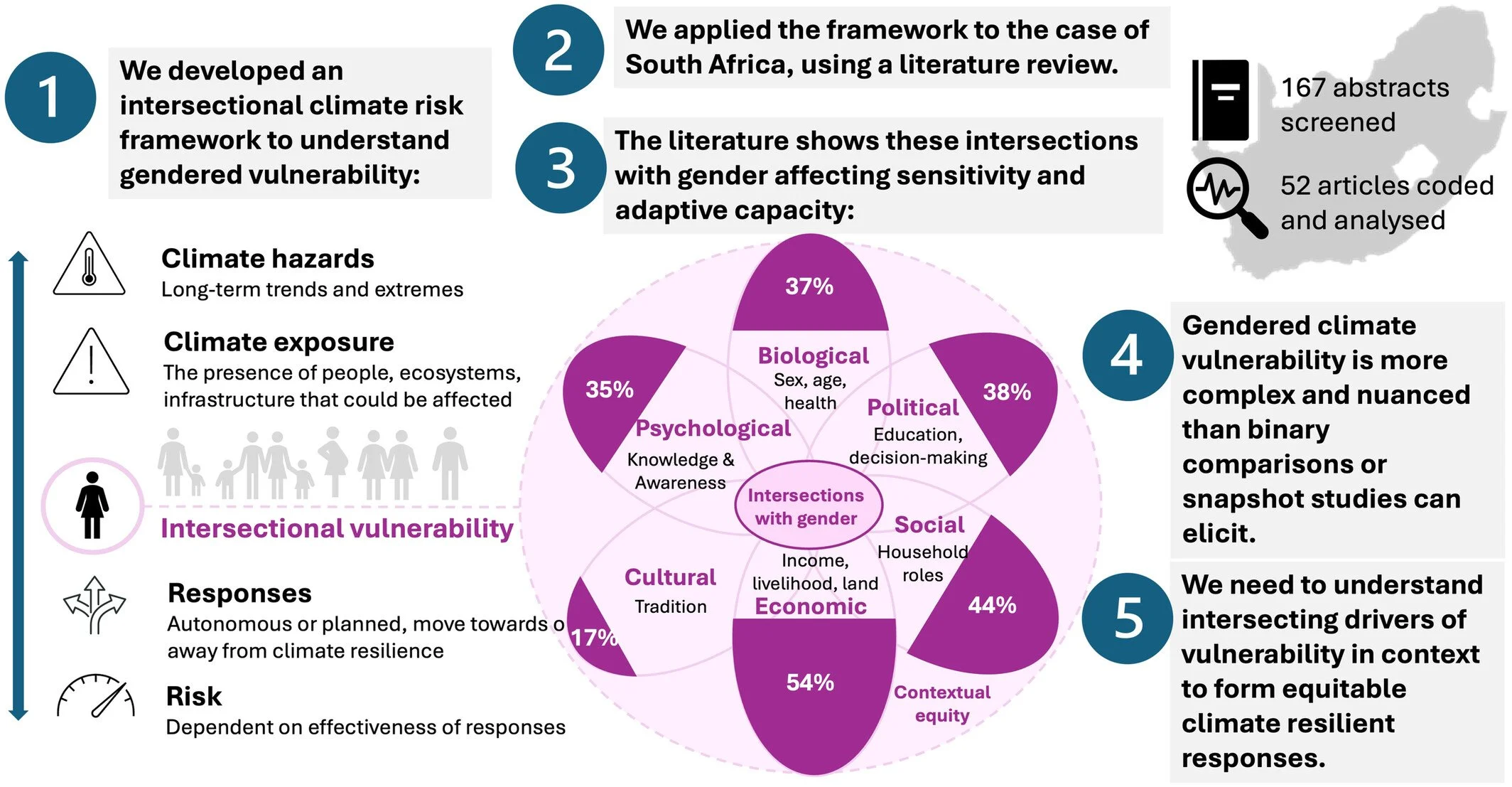
Gender and climate risks
Of the six domains that intersected with gender, including biological, political, social, economic, cultural and psychological, the researchers found that economics - i.e. income and livelihoods - intersected the most with gender to affect vulnerability.
Women and female-headed households were found to be generally poorer than men, and rural women's reliance on agriculture made them highly vulnerable to drought.
The review found that gender shaped autonomous individual and household responses to climate risks. For example, in some cases, women or female smallholder farmers were more likely to adopt adaptation strategies or diversify their livelihoods in response to climate risk. In other cases, they were constrained by education, resources, power dynamics, or their household duties of care.
Equitable climate adaptation responses
In the short-term, researchers suggest gendered approaches to disaster risk reduction, including gender-sensitive shelter, early warning systems and information sharing, are needed.
In the longer term, women’s economic inclusion must be strengthened, so that they can adopt adaptation strategies, manage risk and reduce climate-related losses. Dismantling patriarchal values that underpin gender-based violence, gendered land ownership and household labour would also reduce women’s vulnerability.
The research suggests gendered vulnerability is deeply entwined with historical and socio-economic factors, and needs nuanced, context-specific approaches beyond binary comparisons to be able to develop more equitable climate adaptation responses.
This work was funded by the Government of Flanders (Vlaamse Overheid), through a collaborative agreement between the African Climate and Development Initiative (ACDI) and the South African National Biodiversity Institute (SANBI).
Article citation
Stadler L, Benya S, Ziervogel G, and Holden P. (2025). Integrating intersectionality into climate risk assessments: Review of gendered vulnerability in South Africa. Wiley Interdisciplinary Reviews: Climate Change. https://doi.org/10.1002/wcc.70035
