
Improving representation of African ecosystems in land surface models
Researchers from the University of Exeter, led by PiNC’s Enimhien Akhabue and co-authored by PiNC Lab Lead Petra Holden, have published new research in the Nature's Scientific Data journal that presents their work on improving the representation of African ecosystems in land surface models.
Land surface models such as the Joint UK Land Environment Simulator (JULES) use the parameters of Plant Functional Types (PFTs) to classify plant species into various groups based on their functional characteristics in an ecosystem. PFTs are important for modelling ecosystem processes, vegetation dynamics, carbon dynamics, and climate change.
Historically, the availability and accessibility of ecological data for African plant species is limited. This means that despite the continent’s exceptional biodiversity and ecological importance, Africa’s ecosystems remain underrepresented in most global land surface models.
In this paper, the researchers present a harmonised dataset that systematically maps African plant species to model-relevant PFTs to redress key regional data gaps. The dataset is openly available - including the codebase and methodology - to support accessible, reproducible science.
“By improving how African plant species are classified into model-relevant plant functional types, we help build a stronger evidence base for representing African landscapes more realistically in Earth system science,” says Akhabue.
Closing important knowledge gaps
The researchers classified African plant species from the TRY plant trait database to the JULES PFTs using five classification parameters: growth form, leaf type, leaf phenology, photosynthetic pathway, and climatic zone. Where information was missing, the researchers consulted authoritative databases and peer-reviewed literature to complete the parameters.
As a result, the researchers achieved a sixfold increase in the number of species from the TRY plant traits database that could be linked to the JULES PFT classes, up from 265 to 1,603 (see graph below). In terms of trait observations for PFT-level analysis, the data table delivers a fivefold increase in the number of useable observations from 7,373 to 35,537.
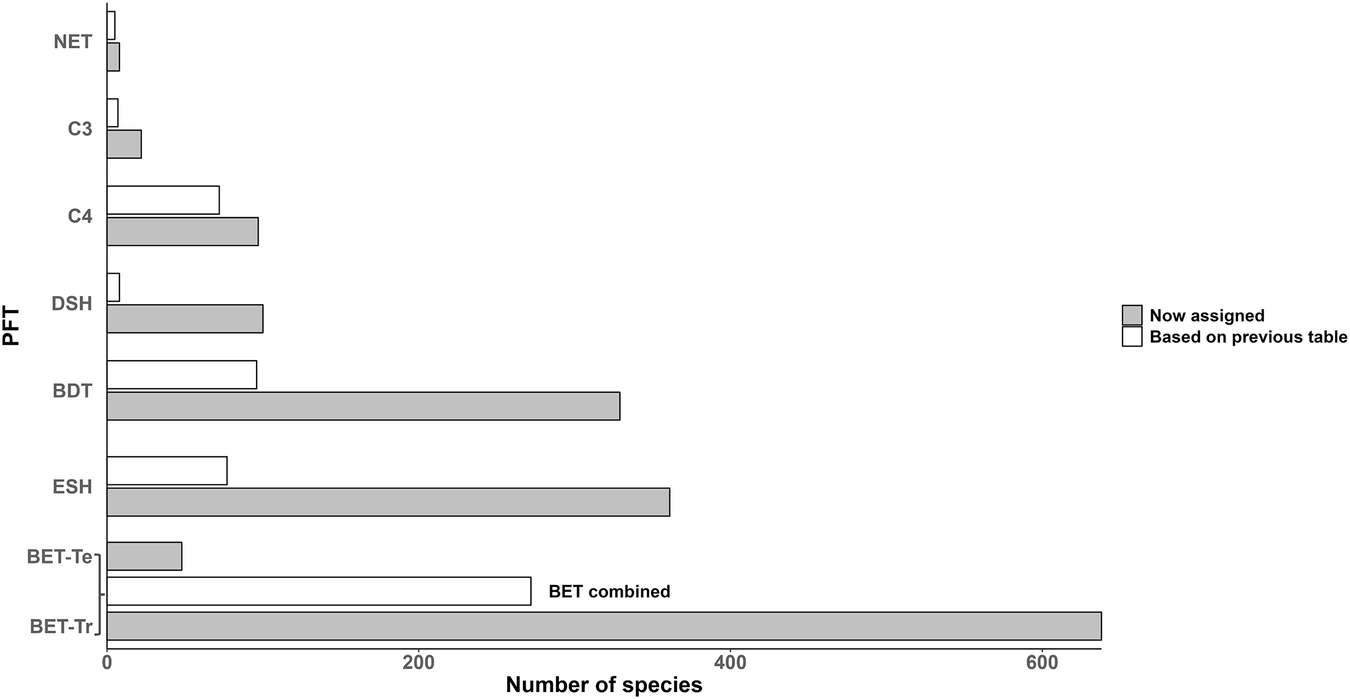
Furthermore, the parameters were systematically identified to enable the wider use of this information to link trait observations to other PFT taxonomies, so that they can be used across multiple land surface models and plant trait based ecological frameworks.
“I hope this research will help close an important knowledge gap by making African plant diversity more visible and usable within land surface modelling,” Akhabue says.
Improving evidence-based decision-making in Africa
This research is an important step in improving the accuracy and relevance of land surface models for African ecosystems.
“By improving model realism with African-specific data, we are not just tuning models, we are making them more equitable, useful, and relevant,” Akhabue says.
Land surface models are essential for understanding how African ecosystems function and how they may respond to climate change and land-use pressures.
“For nature-based solutions, this could provide stronger scientific support for planning, evaluating, and targeting interventions such as restoration, conservation, and sustainable land management in ways that are better suited to African environmental conditions,” Akhabue notes.
“In turn, this can support more informed decision-making in climate adaptation, conservation planning, and sustainable land management across the continent.”
Acknowledgements
This work was supported by the Oppenheimer Programme in African Landscape Systems (OPALS), jointly funded by the University of Exeter, Sarah Turvill, and Oppenheimer Generations Research and Conservation.
Article citation
Akhabue, E.F., Cunliffe, A.M., Bett-Williams, K. et al. (2026) Critical classification parameters linking species to Plant Functional Type in African ecosystems. Sci Data 13, 336. https://doi.org/10.1038/s41597-026-06728-z
